You have a fantastic idea, a solution that will benefit many people or a concept that will — without doubt — become hugely popular. You would rather invest in this brilliant idea today than tomorrow, but three important questions are holding you back:
-
How much can you earn with an app?
-
How can you recover the investment in your app?
-
And which revenue model will generate the most profit for you?
You are certain that people are willing to spend money on your app. But how much? And how often? And in what other ways can an app generate revenue? In short: which revenue models are there, and which model best suits your idea?
In this article, we list the different app revenue models for you, along with their advantages and disadvantages. This helps you determine which revenue model is the most profitable for your app.
How much can you earn with an app?
The revenue generated by an app ranges from a few hundred euros per month to tens of millions of euros per year. Apps in the top ten per cent of the App Store or Google Play generate an average of between ten thousand and one hundred thousand euros per month. Most apps, however, earn significantly less, especially in the early stages.
How much your app earns depends on factors such as the size of your target audience, the level of brand awareness, and the value you offer. But at least as important is the choice of the right revenue model. Each model has its own earning logic and suits a different type of app.
How can you make money with your app?
There are different ways to make money with an app. You can offer a service through an app based on a subscription, or you can provide a solution for which people make a one-off payment. Some apps are particularly well suited to advertising. Other apps generate the most revenue when users can first download a free version, with the option to pay for extras afterwards.
At DTT, we are happy to help you determine which revenue model best suits your idea. We analyse the market, identify the opportunities, and look at the future potential. Together, we then determine which revenue model is the best fit and will deliver the greatest profit. In both the short and long term.
Would you like to brainstorm together and receive no-obligation advice about a suitable revenue model for your app? Feel free to contact us, we would be happy to think along with you!
The 5 best revenue models for an app
Generally speaking, we refer to the following 5 revenue models:
■ A full app revenue model
With a full app revenue model, the user pays a one-off fee for the app. The user immediately receives the full value of the app, without having to pay extra for features or premium options.
■ A freemium app revenue model
With a freemium model, the target audience can download a free app, which gives them access to the main functionalities. The user can then enhance the experience by paying for additional features.
■ A free trial app revenue model
With a free trial app, a user immediately receives full access to the application and all its features. To retain access to the app, the user must then pay for it.
■ An in-app advertising revenue model
With an advertising-based revenue model, you can offer the target audience a free app. You receive a small amount from the advertiser each time the user sees an advert.
■ A sponsorship revenue model
Are you building an app for a niche, and would multiple players in the market benefit from its development? In that case, it is possible that other companies may want to sponsor the development and use of the app.
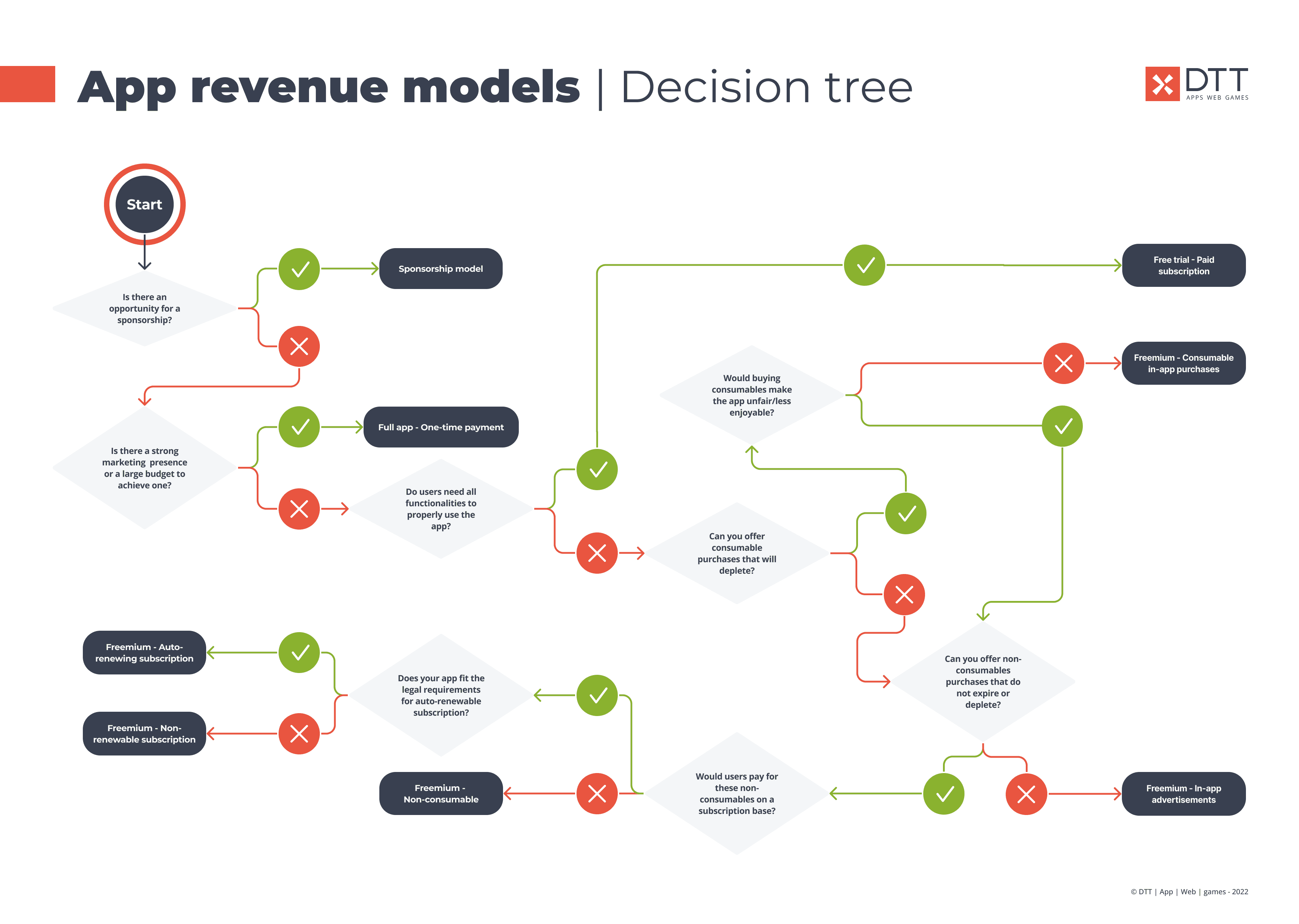
Each app revenue model has its advantages and disadvantages. To help you determine which revenue model best fits your concept, we explain the 5 most popular app revenue models in detail below.
1. Full app - one-off payment
How does a full app payment work?
As the name suggests, with this revenue model the target audience pays a one-off fee for the app. The user immediately gains access to the entire app and all its features. The price you can charge for the app depends entirely on what users are willing to pay.
What is the impact on the user experience?
Because the user pays for the full app, the user experience is generally good. For example, the user does not have to ‘unlock’ additional features, but immediately enjoys the complete experience.
When do you use this revenue model?
■ You have a large reach and strong brand awareness.
■ You want to offer the target audience a complete and valuable experience straight away.
■ You typically invest heavily in marketing to convince your target audience.
■ You have a distinctive proposition compared to (free) alternatives.
An example:
An example of a one-payment app that we developed at DTT is the Elizabeth on Food app. Elizabeth Auerbach already had strong brand awareness and a loyal online audience of over 45,000 followers. This enabled her to offer her app for a one-off payment of €12.99.
|
Advantages |
Considerations |
|
You earn money immediately with every download. |
You only receive payment from users once. |
|
You offer users an optimal experience and the full value straight away. |
Without brand awareness, it is difficult to convince users to pay for the app. |
|
Expectations of a paid app are high, and you need to be able to meet them. |
|
|
You need to invest a relatively large amount of money or energy in marketing. |
|
2. Freemium app revenue model
The freemium app revenue model is one of the most popular revenue models. With a freemium app, you offer users a free version of the app with standard functionalities. A user can enrich the experience by paying to ‘unlock’ additional features, products, premium options, or other benefits.
Within the freemium app revenue model, we distinguish between (2.a) consumable, (2.b) non-consumable, and (2.c) subscription.
2a. Freemium - consumable in-app purchases
How does the revenue model work?
With this revenue model, users can make 'consumable' purchases within the app. These purchases can be used once or for a certain period of time. Think, for example, of extra playtime and special features in a game app. Users can often pay with real money or the app’s virtual currency.
What is the impact on the user experience?
The in-app purchases can either improve or reduce the experience. For example, users may become frustrated because they have to pay for extras. An app can also lose value if players can indirectly pay for their progress. To safeguard the user experience and the value of the app, a good balance is of great importance.
When do you use this revenue model?
■ This revenue model is popular in, among other things, games, wellbeing service apps, and entertainment.
■ You can offer consumable purchases that enrich the experience.
■ You can offer a good balance between free and premium content and features.
■ You have a strong strategy for a successful virtual economy.
■ You target an older audience, or you can protect younger users from financial consequences.
Examples:
Popular examples of freemium apps with consumable purchases include Candy Crush Saga, Fortnite, Clash of Clans and Bumble.
|
Advantages |
Considerations |
|
The app is very accessible for users to start using. |
Many users will not proceed to paid purchases. |
|
You can relatively easily appeal to and retain a large audience. |
Having to purchase extras can cause frustration. |
|
Users can try the main functionalities and in this way get to know the value of the app. |
You need to actively encourage users to keep making purchases. |
|
The purchases improve and enrich the user experience. |
|
|
Loyal users are often willing to continue making purchases. |
2b. Freemium – non-consumable in-app purchases
How does the revenue model work?
In this freemium revenue model, users can make non-consumable purchases. This means they gain permanent access to premium features. Think of hidden levels or new characters in games. It may also involve photo filters, additional services, or new content.
What is the impact on the user experience?
This revenue model generally has a positive effect on the user experience, because the purchases cannot be consumed or expire. Users continue to have access to the extras or premium content.
When do you use this revenue model?
■ This revenue model is popular in, among other things, games, wellbeing service apps, and entertainment.
■ You can offer users extra features, services, or new content.
■ You can regularly expand or refresh the content.
■ You can offer a good balance between free and premium content and features.
Examples:
An example of a freemium non-consumable app developed by DTT is the Doula Bevallingcoach app. The app supports women during contractions. The user can ‘unlock’ other functions, such as background music or breathing coaching. Other apps that use this revenue model are Breeze and The Sims FreePlay.
|
Advantages |
Considerations |
|
The app is very accessible for users to start using. |
Many users of a free version will not proceed to purchases. |
|
You can relatively easily appeal to and retain a large audience. |
Users cannot try paid features first. |
|
Users can try the main functionalities and in this way get to know the value of the app. |
You need to add new content in order to continue earning from existing customers. |
|
The user experience is consistently enriched through purchases. |
You need to continue actively encouraging users to make purchases. |
|
Loyal users will quickly be willing to pay for new features |
2c. Freemium – paid subscription
How does the revenue model work?
With the freemium subscription revenue model, users can first download a free version, after which they can take out a subscription to gain full access to the service, extra features, or content. Think, for example, of media, a professional tool, or cloud storage. There is often a choice between different subscription types and durations.
What is the impact on the user experience?
This revenue model has a positive effect on the user experience, because the subscription offers more possibilities and enriches the overall experience. However, in order to attract more subscribers, it is important that you already offer a valuable experience with the free app, before anyone takes out a subscription.
When do you use this revenue model?
■ This revenue model is popular in, among other things, apps for online tools, productivity apps, media, and entertainment apps.
■ You want to generate a stable and predictable revenue stream with the app.
■ Your offering is unique and clearly distinguishes itself from that of competitors.
■ You have the ability to adapt, refresh, and enrich the content or service.
Examples:
A good example of freemium with a subscription model is the VoNo app. The Voice Note Memo to Mail app offers users the ability to send themselves voice memos. Use is free, but with a subscription you get more storage space, more features, and an ad-free user environment. Other examples are Duolingo, LinkedIn, Dropbox, Todoist and Spotify.
|
Advantages |
Considerations |
|
With the free version, you can attract many potential customers. |
Many users of the free version will not proceed to purchases. |
|
Subscriptions offer a steady and predictable income stream. |
There may be a lot of competition, which can make it difficult to stand out. |
|
You can increase subscription prices over time |
You need to refresh or enrich the content or service regularly. |
|
With a subscription, users pay small amounts periodically, which lowers the barrier. |
|
|
You can convince the target audience with a free trial subscription. |
|
3. Free trial – paid subscription
How does it work?
With the free trial model, users can first try the app and service in full. After the free trial period, they can continue using the app and service by taking out a subscription. With this revenue model, unlike the freemium model, there is no free basic version of the app available once the trial subscription ends.
What is the impact on the user experience?
It is important to offer a good user experience with a free trial app in order to convince users to take out a paid subscription. Because the entire app — including all functionalities — is made available through a subscription, the user enjoys an optimal experience.
When do you use this model?
■ You offer an app or service for which users need the full experience in order to understand the app’s value.
■ You aim for a stable and predictable income stream.
■ Your offering is unique and clearly distinguishes itself from that of competitors.
■ You can refresh, enrich, and continuously differentiate the content or service.
Examples:
Good examples of a free trial followed by a paid subscription are Disney+, Headspace, Faceapp, YouTube Red and Apple TV+.
|
Advantages |
Considerations |
|
The free trial is often only used by leads who are genuinely interested in the app and the subscription. |
Because users know that they need to take out a subscription, they are often not interested in the free trial. |
|
Costs of free downloads and irrelevant sign-ups remain limited. |
Users may also intentionally only take advantage of the free trial, without wanting to take out a subscription afterwards. |
|
Users experience the full value, making them more likely to take out a subscription. |
In the start-up phase, it is difficult to retain subscribers and generate enough revenue. |
|
With a subscription, you generate a stable and predictable income stream. |
You need to keep the app relevant and enrich it to prevent cancellations. |
|
You can easily expand subscriptions or offer upgrades. |
Growing competition can make it difficult to retain subscribers. |
4. In-app advertising revenue model
How does it work?
With in-app advertising, you can offer users a free app by showing them adverts. Each time the user sees or clicks on an advert, you earn a small amount. You can also allow users to pay for a premium account in order to use the app without adverts.
What is the impact on the user experience?
Adverts come in many shapes and sizes. One advert can hinder the user experience more than another, for example a full-screen ad versus a banner. It is important to find a balance in which the adverts generate sufficient revenue while also safeguarding a good user experience. Users can often also watch video adverts in exchange for extras, which can enrich their experience.
When do you use this model?
■ You want to offer users a free app while still generating revenue.
■ You have a large number of users, so that the adverts generate enough income.
■ You can incorporate adverts into the app without the user experience being perceived as negative.
An example:
A good example of the in-app advertising revenue model is YouTube, where personalised ads are shown to users. Users can also choose to pay for an ad-free experience.
|
Advantages |
Considerations |
|
You can offer users the full app and experience free of charge. |
Adverts often hinder the user experience. |
|
Because users experience the value of the app, they are often willing to pay for a premium account or subscription. |
You need a large number of loyal users to make this model profitable. |
|
Ad blockers can pose a threat to this revenue model. |
|
5. Sponsorship revenue model
How does it work?
If you build an app for a particular niche, it may be possible to collaborate with other players in the market. In exchange for payment, you then promote other companies by showing logos or adverts, offering complementary products, or through content marketing.
What is the impact on the user experience?
The extent to which this revenue model affects the user experience depends entirely on the method of promotion. Displaying logos hardly affects the user experience, whereas showing adverts may do so. Promoted content may be experienced as annoying, while an additional service may be seen as an enhancement.
When do you use this revenue model?
■ You offer an app that is interesting to a large but specific audience.
■ You can offer brands something that adds value for them, for you, and for users.
■ You can promote a brand without hindering the user experience.
An example:
A good example of this revenue model is the partnership between Headspace and Nike. Athletes can improve their performance by using Headspace’s guided meditation (Nike News, 2018).
|
Advantages |
Considerations |
|
Together, you can make more possible and enrich the app and each other’s service. |
It is challenging to secure a good sponsorship deal. |
|
Together, you can attract more users. |
With a sponsorship deal, you are partly dependent on the sponsoring party. |
|
With a large customer base, you can attract more and more sponsors. |
Creating a profitable app together with DTT
The revenue model that suits your idea depends on many factors. At DTT, we are happy to help you determine which revenue model will generate the most in your specific case. In both the short and long term. We then help you use the reserved budget as efficiently as possible to develop a profitable and future-proof app. Want to know more about our work method? Read more about it on our work method page.
From the very first brainstorming session, through the development of the application, right up to ongoing support: together, we maximise the results of your app. Now and in the future!
Would you like to discuss your project? We’d be delighted to.
Would you like to have an app developed, or would you like to brainstorm about your idea with no obligation? Tell us more about your plans, wishes, or challenges. We will immediately think along with you and answer your most important questions. Feel free to contact us.