More and more organisations are exploring what AI transformation can deliver in practice. The most valuable applications emerge when new technologies are used to organise work more intelligently.
In this article, you will discover what AI transformation means in practice, where the first opportunities lie, and how organisations are getting started with it in concrete terms.
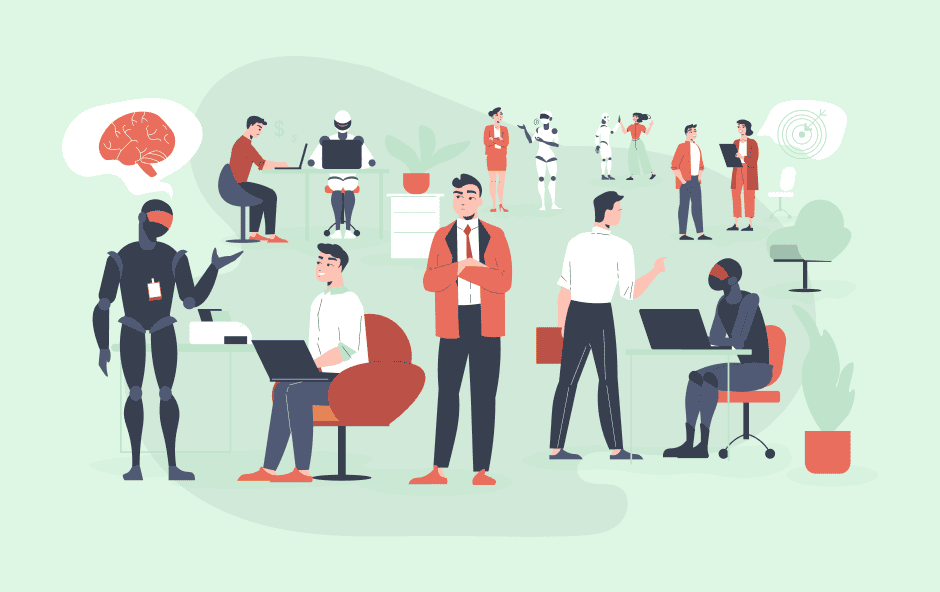
AI transformation is about organising work more intelligently with AI, allowing your team to focus more on work with impact: customer contact, analysis, collaboration, quality assessment, and specialist tasks.
That is the core of AI transformation. By applying AI intelligently, more room is created for work where human attention, expertise, and collaboration truly make a difference.
What AI transformation means in day-to-day practice
AI-transformation may initially feel abstract. The exact implementation differs per organisation, team, and process. Nevertheless, in practice we often see the same patterns recurring in how work changes and where teams experience more room.
After AI transformation, your team may, for example, be able to focus more on:
- personal customer contact;
- analysis and decision-making;
- assessing exceptions and quality;
- specialist expertise and work with greater impact.
And after AI transformation, your team will spend less time on:
- manual research tasks;
- repetitive actions and administration;
- standard checks and repetitive process steps.
For many organisations, AI transformation therefore starts with process automation, workflow improvement, and organising day-to-day business processes more intelligently. The expected impact usually revolves around three concrete effects:
- time savings in repetitive tasks;
- higher quality and greater consistency in execution;
- greater agility and capacity within existing teams.
In practice, this may look like the following:
| Situation | Without AI support | With AI support | Estimated time savings per month |
|---|---|---|---|
| Processing customer enquiries | Employees search for information across multiple documents and manually write responses | AI creates a first draft response based on internal knowledge and a fixed tone of voice | 8 to 16 hours |
| Minutes and summaries | Meetings are manually summarised and action points are tracked separately | AI summarises conversations and clearly organises action points | 4 to 10 hours |
| Preparing quotations or proposals | Information is repeatedly gathered from previous documents | AI creates a first proposal using fixed building blocks | 6 to 12 hours |
| Administrative checks | Data is manually checked for completeness and discrepancies | AI identifies missing information and flags discrepancies more quickly | 6 to 14 hours |
The exact gains differ per organisation, but examples like these demonstrate how a first AI application can immediately become noticeable in day-to-day operations.
Doubts about AI require a practical starting point
In conversations about AI transformation, we often hear remarks such as:
“We are not ready for AI yet; we are already lagging behind in terms of digitalisation.”
“We first want to know where AI will genuinely deliver value.”
“We want to avoid AI becoming a collection of disconnected experiments without results.”
“We are looking for an approach that remains manageable for our organisation.”
These questions are understandable. AI is developing rapidly, the possibilities are broad, and for many organisations it is difficult to determine where the greatest value lies and how to approach it sensibly.
That is why we help organisations translate AI into day-to-day practice in a practical and manageable way. Together, we identify where AI can immediately add value, how risks remain manageable, and which first step logically fits the organisation. We also consider support within teams, ways of working, return on investment, and the possibility of scaling further in the future.
This creates a first application that starts accessibly, delivers visible results, and at the same time forms a strong foundation for future steps.
Why organisations are investing in AI transformation right now
In recent years, AI has become far more practical and accessible. Applications that were previously experimental are now usable within day-to-day processes. As a result, the question is increasingly shifting from “is this possible?” to “where does this deliver immediate value?”.
At the same time, pressure on capacity is increasing within many organisations. Work volumes are growing, while teams cannot always expand easily. That is precisely why organising work more intelligently is becoming increasingly important: making processes more efficient, reducing repetitive work, and giving employees more room for impactful tasks.
Organisations leading the way in this area primarily use AI to help existing teams work more effectively. Not by replacing people, but by making processes faster, more consistent, and more scalable.
At DTT, the focus is therefore not on the technology itself, but on the day-to-day reality of teams and processes. We look at where AI can directly help improve quality, speed, or capacity. From that emerges a first application with visible impact and a realistic AI roadmap that remains manageable for the organisation.
Our focus is on:
- practical applications with immediate impact;
- process improvement rather than disconnected experiments;
- an approach that remains executable, measurable, and scalable.
This creates an approach to AI transformation that remains accessible, generates internal support, and gradually works towards structural improvement.
From initial gains to structural change
AI transformation is not a one-off intervention. It is a development in which organisations continuously learn to look more critically at how work is organised and where technology delivers the greatest value.
The first gains are often found within a clearly defined process. From there, you can continue building on what works.
Would you like to explore where AI could immediately deliver time savings, quality improvements, or additional capacity within your organisation? DTT would be happy to think along with you in a no-obligation conversation, with tailored advice on the opportunities that fit your processes, objectives, and way of working.