How do you make sure employees can use AI to quickly get answers to questions about internal documents, customer data or ongoing processes?
With Retrieval Augmented Generation (RAG), AI can use information from your own business sources to provide relevant answers. By connecting this technology to existing business software through an API, such as an ERP or CRM system, AI can also retrieve up-to-date data. This makes business information easier to access and helps employees move forward faster.
A RAG system makes business knowledge accessible through AI. Employees ask a question and receive an answer based on internal documents, manuals and knowledge bases. But what happens when the answer is not in a document, but in your current business software?
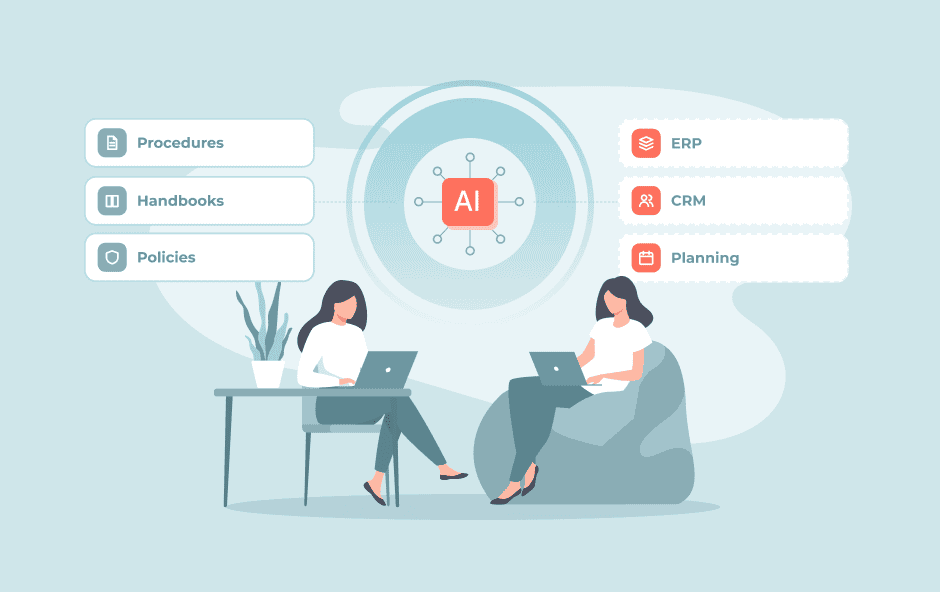
By connecting a RAG system through an API to systems such as an ERP, CRM or planning environment, AI gains access to up-to-date and relevant business data. A smart knowledge base thus grows into a digital assistant that actively works alongside your organisation.
From business knowledge to up-to-date business information
Retrieval Augmented Generation (RAG) combines an AI model with information from selected sources. Instead of relying solely on general training data, the system first searches for relevant information within your own organisation.
In our article on RAG systems based on your own business knowledge, we explain how this approach enables reliable and verifiable answers.
Documents form a valuable foundation for this. Think of policy documents, manuals, contracts, work instructions and frequently asked questions. However, these sources mainly describe what has been agreed or how a process should run. They do not always tell you what is happening right now.
The status of an order, for example, is in the ERP system. Current customer information is in the CRM. Available capacity is in the planning and open tickets are in a ticketing system. To answer operational questions, AI therefore needs to look beyond documents.
How does a RAG system work with an API connection?
An API allows different digital systems to exchange information securely. When a user asks a question, the RAG system determines which information is needed. The connection then retrieves only the relevant data from the right source system.
A service employee could, for example, ask which tickets are still open for a client. The system retrieves the current information from the service environment and combines it with relevant work instructions from the knowledge base. The AI model then turns this data into a single, clear answer.
This brings two types of information together:
- Up-to-date data from business software
- Context and explanation from internal knowledge sources
It is precisely this combination that makes a connected RAG system valuable. The system not only knows what the current situation is, but also understands which agreements, processes and next steps belong to it.
What does a connected RAG system deliver?
A RAG system with access to up-to-date business data reduces the time employees spend searching, checking and switching between systems.
An account manager gains faster insight into client agreements and ongoing projects. A service employee immediately sees which ticket has priority. A manager can have current information from multiple systems summarised. Employees no longer need to open each system separately and combine the data themselves.
Moreover, the application is not limited to answering questions. Depending on how it is set up, AI can also summarise information, flag deviations, prepare actions and guide employees through a process.
This way, RAG becomes not a separate search function, but a smart layer within the existing digital work environment.
Handling business data securely
A connection to business software requires a careful setup. After all, not every user is allowed to view the same information.
Access rights from existing systems must therefore also apply within the AI application. An employee only receives answers based on data they are authorised to access. In addition, it must remain clear which source was used for an answer.
The availability of systems also plays a role. When a source is temporarily unavailable, the AI application must clearly indicate this. The system must never fill in missing information itself or present it as fact.
A reliable solution therefore requires more than an API that works technically. Security, roles, data quality, speed and error handling must be part of the design from the very beginning.
Start with the question, not the technology
Not every data source needs to be connected to AI straight away. A successful application starts with concrete questions from within the organisation.
What information do employees look for every day? For which answers do they open multiple systems? Where do delays or errors occur because data is scattered? And what knowledge is needed to interpret the information correctly?
Based on these questions, you can determine which sources add the most value. A focused first application is often more effective than an extensive connection to all available systems.
A RAG application can then be expanded step by step. First with a clearly defined knowledge base, then with up-to-date data from one key system, and eventually with additional processes and functionality.
RAG as part of AI transformation
A connected RAG system shows how AI can become a practical part of existing processes and software. The technology does not replace current systems, but makes the information in them more accessible and more usable.
This makes RAG part of a broader AI transformation. Organisations look not just at a single AI application, but explore how processes, systems and teams can work together more intelligently in a structural way.
Would you like to add AI to an existing app, platform or digital work environment? With a targeted AI integration, existing software can be extended with features that suit the users, processes and goals of your organisation.
DTT helps organisations determine the right application and integrate it securely within their existing digital landscape. The result is not a standalone AI experiment, but a scalable solution that adds value straight away.