Artificial Intelligence: smart digital solutions


Make AI a reality within your organisation and discover where an initial AI application can free up time, strengthen processes and enable teams to work smarter.
Many organisations know that AI is relevant. The challenge lies in the first step: what exactly is AI transformation, where do you start, which application really delivers results and how do you ensure it fits into day-to-day practice?
DTT helps organisations make AI practically applicable within processes, systems and teams. This creates a clear path from the initial opportunity to a working AI application, AI implementation and further scaling.
Completely no-obligation · Contact within 1 business day · Clear next steps











DTT really pulled this off in record time; I’m very impressed. A highly professional, well-coordinated team. Definitely the right choice!


From strategy and UX to development and maintenance. One partner that oversees and executes the entire process.
Since 2010 we have built digital solutions for startups, scale-ups, SMEs and multinationals—across virtually every sector.
With dozens of technologies in-house, we always choose the solution that best fits your product and objectives.
You work directly with our Dutch team. That means short lines, fast iterations and consistent quality.
From a sharp pilot to international rollout. We think in phases and get the most out of every budget.
AI transformation is about organising work more intelligently. It concerns the way processes are structured, how tasks are distributed, and where employees currently spend their time. When AI is applied in the right places, the focus within teams shifts.
After AI transformation, your team can focus more on:
And after AI transformation, your team spends less time on:
For many organisations, AI transformation therefore starts with process automation, workflow improvement, and organising daily business processes more intelligently. For organisations, the expected impact usually revolves around three concrete effects:
AI transformation affects the way work is organised. In many organisations, recurring actions, checks, and handovers take up time every day. Once such steps are organised more intelligently, space is created for work that adds more value.
That effect is particularly relevant now. Teams are under pressure, processes are becoming more complex, and the demand for speed and quality is increasing. Organisations that respond to this in a focused way build more operational strength step by step.
You can see this reflected in the concrete benefits of AI transformation:
This often becomes tangible quickly in processes that feel familiar, recur regularly, and take up a lot of time without adding extra value.
| Situation | Without AI support | With AI support | Estimated time savings per month |
|---|---|---|---|
| Processing customer enquiries | Employees look up information in multiple documents and write responses manually | AI creates an initial draft response based on internal knowledge and a fixed tone of voice | 8 to 16 hours |
| Minutes and summaries | Meetings are written up manually and action points are tracked separately | AI summarises conversations and clearly prepares action points | 4 to 10 hours |
| Preparing quotes or proposals | Information is repeatedly collected from previous documents | AI structures input and creates an initial draft using fixed building blocks | 6 to 12 hours |
| Answering internal questions | Colleagues search for scattered information in manuals, emails, and documents | AI unlocks internal knowledge and provides a usable first answer more quickly | 5 to 12 hours |
| Administrative checks | Data is manually checked for completeness and deviations | AI identifies missing information and flags deviations more quickly | 6 to 14 hours |
The exact gain differs per organisation, but examples like these show how a first AI application can have an immediate impact in daily practice.
Many AI initiatives start with enthusiasm, but lack direction once daily practice comes into view. It then remains unclear which process has priority, which application genuinely helps, and how the solution fits with existing ways of working, systems, and responsibilities.
This creates fragmentation rather than progress. Teams try different tools, applications lack clear ownership, and results remain difficult to measure. Organisations benefit most from focus: a clear choice for a process where time savings, quality improvement, or capacity gains are immediately noticeable.
This is exactly where DTT helps: we identify where the most value lies, which first step makes sense, and how to translate that into an approach that works in daily practice.
A strong first step starts with the process. Where is time being lost? Which tasks recur often? Where does an application directly support employees in their work?
Based on that analysis, we translate AI opportunities into a clear first route:
This creates clarity about what makes sense, which step delivers return, and how AI fits the way your organisation works today.
AI transformation is relevant for organisations that see opportunities in AI and want to work with it in a focused way.
Organisations with a lot of manual work, scattered information, or recurring checks can often also take a valuable first step quickly. These are often exactly the areas where the greatest room for AI automation and a first practical AI roadmap emerges.
A first trajectory around AI transformation should above all provide clarity and applicability. That is why we work towards an outcome that an organisation can continue with immediately.
You receive:
This provides guidance for decision-making and makes the first step concrete enough to build internal support.
The value of AI becomes visible when an application connects with processes, systems, data, and teams. AI then strengthens the way work is carried out day to day and supports teams in recurring tasks.
That is why we always look at the relationship between process, application, and organisational context. A solution becomes stronger when it is clear:
In this way, AI develops into a useful layer within operations and creates structural impact on time, quality, and capacity.
We keep the trajectory clear and practical. In short steps, we work from insight towards a first result.
This approach provides speed, direction, and room to continue building in a well-founded way. This creates a first promising AI application within a realistic AI roadmap: from analysis to implementation.
The first application shows where AI helps in practice. From that moment on, more insight emerges into usage, effect, and further opportunities within the organisation.
This makes it possible to organise similar processes more intelligently, better align applications with each other, and make AI a structural part of the way of working. In this way, an initial success grows into broader AI transformation, where efficiency, quality, and innovation reinforce each other.
Many organisations wonder whether this is already the right moment. In practice, the first gains often emerge precisely in places with a lot of manual work, scattered information, or teams losing time on recurring steps.
A good start mainly requires a suitable first application. Once it aligns with daily practice, AI becomes understandable, usable, and relevant for the organisation.
DTT guides that first step both substantively and practically. This creates an approach that fits the team, the processes, and the organisation’s goals.

New business director
Not quite sure what you need yet? Joost will help you clarify your ideas and turn them into feasible, concrete options.


New business director
Not quite sure what you need yet? Joost will help you clarify your ideas and turn them into feasible, concrete options.
We will contact you within one business day to discuss your project and schedule a meeting. This way we can immediately connect you with the right specialists.
We schedule a no-obligation introduction at our office in Amsterdam or online. No preparation or technical knowledge required. We discuss your idea and involve the experts that match your question.
After the meeting, our experts draw up a free advice and proposal, tailored to your situation and ambitions. You receive technical advice, a plan of approach and insight into the resources and timeline needed. So you know exactly what to expect.
Take your time to review the proposal. We are happy to present it in person and explain everything. Do you have questions, new insights or additional wishes? Then we will sharpen the proposal further.
Is the proposal approved? Then our collaboration officially starts. We build your app step by step, transparently, involved and together. Read more about our working method here.
Our approach combines strategy, design, software development and AI to accelerate digital processes and deliver solutions that are ready for further growth.

Fast results
In short steps to a first working version that adds immediate value.

Transparent budget
Clear upfront insight into scope, planning and investment.

Launch with certainty
We handle the full launch, so that you can focus on growth and further development.
Our collaboration kicks off with a kick-off session in which we zoom in on the desired solution and objectives. In an open atmosphere, we ask questions, challenge, and inspire with relevant, promising possibilities.

The loyalty app that connects & rewards green thumbs. For a growing and flourishing customer base
Swiping green fingers connect and reward

A sustainable solution for a safe road network
Using AI to map all national roads intelligently

Serious topic for a serious game in >8,000 classrooms
National Serious Game: teaching children media literacy
DTT has been there for entrepreneurs and enterprising changemakers since 2010. As a full-service development agency, we create apps, games and web solutions for all types of clients, including government agencies, multinationals, healthcare, NGOs, start-ups, investors and SMEs.
Custom software, app development, AI integrations, digital strategy and ongoing development.
We do it all, with one team in the center of Amsterdam.
In consultation, we tailor our digital services to the needs and wishes of our clients.
Please feel free to contact us for tailored advice. We are happy to help you move forward digitally.
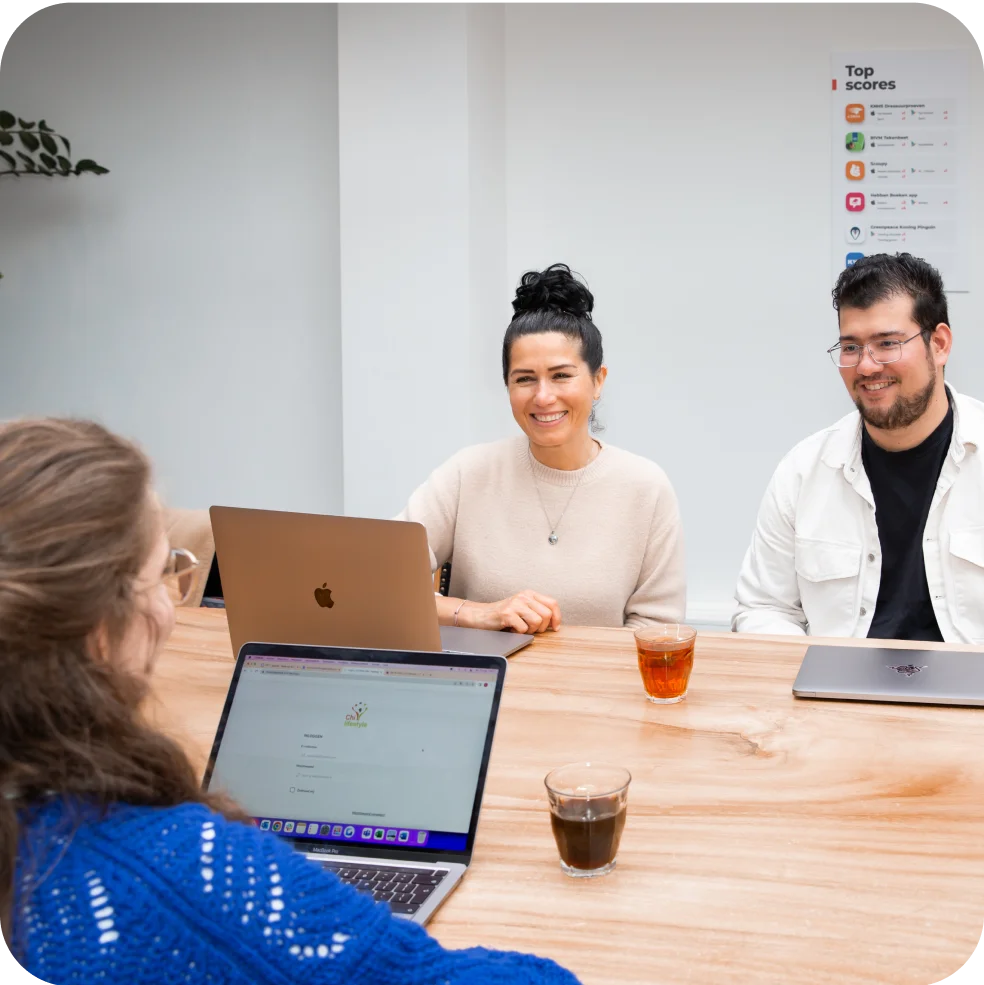

AI transformation is all about organising work more intelligently with the help of AI. It is not just about technology, but primarily about processes, tasks and day-to-day work. AI helps to carry out repetitive tasks more efficiently, minimise wasted time and work more consistently, thereby creating more scope for human interaction, creativity and strategic thinking.
The best place to start is usually with a specific process. By first identifying where time is being wasted, which tasks are frequently repeated and where quality improvements can be made, it quickly becomes clear which AI application makes the most sense to implement first.
An initial application is most effective when it directly addresses day-to-day operations. Think of processes involving a lot of manual work, checks, information transfer or repetitive tasks. That is where time savings and improvements in quality are usually most quickly apparent.
AI transformation typically results in time savings, greater consistency, fewer errors, shorter lead times and more flexibility within teams. The exact impact varies from process to process, but is often first evident in routine tasks, checks, document processing and knowledge sharing.
An initial AI roadmap identifies which processes are a priority, which AI applications will have the greatest impact, what is feasible within the organisation, and what the logical next steps are. This provides a solid foundation for an initial AI implementation without the approach becoming too ambitious or too abstract.
No. Medium-sized and small organisations can also quickly realise value, particularly as processes become more complex and teams are required to do more with the same resources. The first step doesn’t have to be a big one, as long as it’s the right one.
It starts with a clear commitment to the process, the objective and the people responsible. By integrating AI with existing systems, working methods and measurable outcomes, you create an approach that goes beyond a pilot or a one-off trial.
Discover where the greatest opportunities lie within your organisation and how AI can deliver immediate value in day-to-day operations. Schedule a no-obligation introductory meeting to discuss which initial AI opportunity makes the most sense for your processes, teams and objectives.