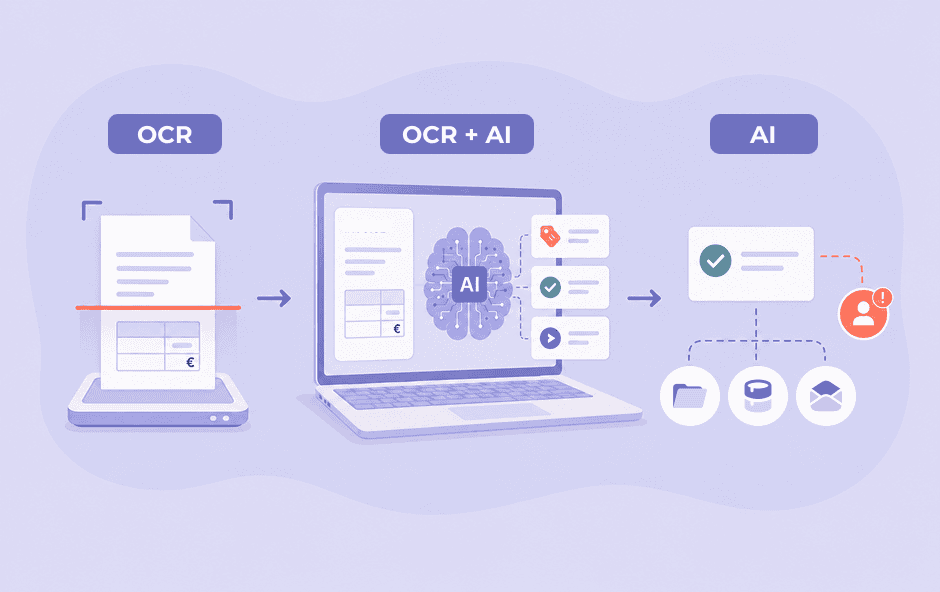
OCR converts text from an image, scan or PDF file into digital information. AI goes further and can interpret, check and process this information. OCR AI combines both techniques, so documents not only become readable, but become part of a smart digital process.
The question, then, is not whether OCR or AI is the smarter technology. The relevant question is which solution makes your process demonstrably faster, more reliable and more scalable.
What is OCR?
OCR stands for Optical Character Recognition. This technology recognises letters, numbers and other characters in an image and converts them into digital text.
Think of a scanned invoice. Without OCR, software only sees an image. With OCR, the text can be selected, searched and processed further. The system recognises, for example, a company name, a date and an amount. OCR therefore reads what is on the document, but does not automatically understand what this information means. The technique can recognise an amount without knowing whether it is the total, the VAT or a subtotal.
What is the difference between OCR and AI?
The main difference is that OCR recognises information, while AI can interpret it.
OCR makes text digitally available. AI can then determine what type of document it is, which data is important and what action is needed. An AI model can, for example, recognise that a document is an invoice, select the correct total and check whether it matches an order.
AI is also better at handling documents with different layouts. An invoice number is not in the same place for every supplier. By looking at language, context and document structure, AI can still identify the right data.
So OCR recognises the information. The real digital value comes when this information is used reliably within a working process.
What is OCR AI?
OCR AI is the combination of text recognition and artificial intelligence. OCR extracts the text from a document. AI gives meaning to the recognised information and determines how it can be used within a process.
An incoming document can, for example, be classified automatically. Relevant data is then extracted and checked. If everything is correct, the information can go straight to an accounting system, portal or internal system. Only documents with discrepancies are still reviewed by an employee.
The value is not just in reading faster. Recognition, checking and processing come together in one digital process.
When is plain OCR enough?
OCR is a suitable choice when documents have a predictable layout and the extracted text needs little interpretation.
This applies, for example, to digitising an archive. Employees want to be able to search documents, but the information does not need to be checked or forwarded automatically.
OCR fits best when documents almost always have the same structure, the scan quality is good and the text only needs to be searchable or copyable. An employee must also be able to check the outcome easily.
When does AI add value?
AI becomes relevant when documents are the start of a larger work process.
Think of organisations that process invoices, contracts, forms or applications every day. Employees copy data, check information and carry out the same actions in different systems. That takes time and increases the risk of errors.
With AI, documents can be recognised and processed automatically. Business rules can be applied along the way. An amount can be checked, missing information can be flagged and a document can be sent to the right department.
An AI integration makes it possible to add such features to an existing application or digital platform. The current solution stays in place, while specific processes are set up more intelligently.
How do you choose between OCR and AI?
A good choice does not start with the technology, but with the process. Which tasks currently take a lot of time? Where do errors occur? What information needs to be extracted from documents and what happens to that data next?
DTT looks beyond the percentage of correctly recognised text. The consequences of an error, the checks required and the connection with existing software also determine whether a solution works in practice.
A high recognition score has little value when employees still have to copy the result manually. That is why we look at, among other things, the variation in documents, the quality of the available data, human review, privacy, security and the ability to scale up later.
By starting with one document type and one clear process, the technical feasibility can be tested in a focused way. The results then form the basis for further development.
From recognition to a working digital process
OCR and AI are not goals in themselves. The value comes when technology saves time, reduces errors and works well with existing systems.
Together we determine where OCR is enough, where AI adds extra value and which checks are needed. We then translate this into a digital solution that works reliably and can grow with your organisation.
Does your process call for specific functionality, data sources or integrations? With custom software development, we bring these components together in one scalable solution.